How Attackers Turn Your Own Infrastructure Against You - Chain by Chain

Pamela Weaver
Securin Team


April 9, 2026
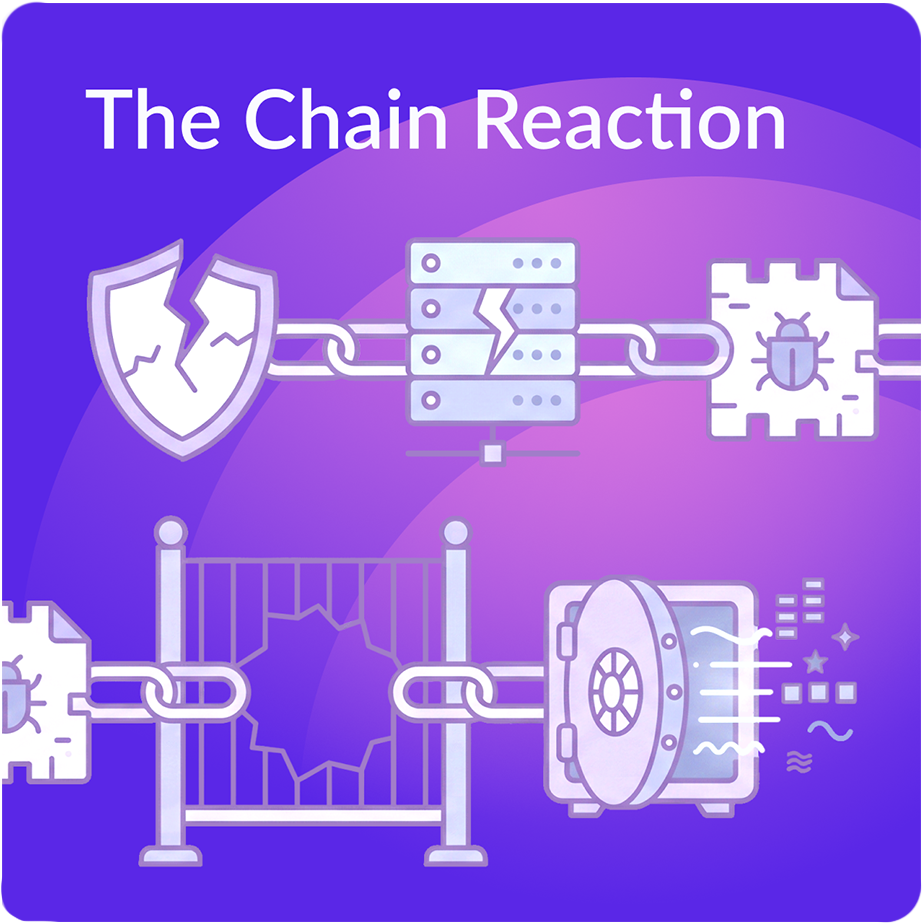
The end of the ‘Single CVE’: How ransomware groups are engineering orchestrated trust failures. To show how trust failures are orchestrated, we broke down 2025’s exploitation patterns into three logically distinct chains - patterns now being replicated and accelerated by automated systems. Here’s what you need to know.
For years, security teams treated exploitation like a plumbing issue: find the leak, patch the hole, move on. Securin’s 2025 Ransomware Index shows that model is finished. Modern ransomware campaigns are no longer built around a single clever exploit, they’re engineered chains of failures designed to dismantle trust layer by layer - until the environment effectively authorizes its own takeover.
Today’s attackers aren’t just breaking in; they’re re-writing how systems decide what to trust. By linking authentication bypasses, privilege escalations, platform flaws and firmware exploits, ransomware groups turn ordinary infrastructure into attack infrastructure.
What does that look like in practice? We mapped the major campaigns of the past year into three distinct patterns. Here’s what we found.
1. The platform takeover chain: SharePoint.
Enterprise collaboration platforms were built to connect people. In 2025, they became launchpads for ransomware campaigns. The SharePoint chain shows how attackers can methodically convert a trusted internal tool into a full-access control plane.
Instead of a single entry point, groups like 4L4MD4R and Warlock used a multi-stage chain to turn a collaboration hub into an attacker-controlled gateway.
Phase | Vulnerability | Weakness (CWE) | Operational Impact |
Initial Access | CVE-2025-49706 | Improper Authentication (CWE-287) | Bypass identity checks to access the ToolPane endpoint. |
Execution | CVE-2025-49704 | Code Injection (CWE-94) | Execute malicious reflective code in memory via POST requests. |
Persistence | CVE-2025-53770 | Deserialization of Untrusted Data (CWE-502) | Leverage insecure ViewState handling to maintain unauthenticated RCE. |
Escalation | CVE-2025-53771 | Authentication Bypass (CWE-288) | Extract cryptographic secrets (machineKeys) to forge enterprise-wide tokens. |
Individually, these flaws look routine. Chained together, they turn SharePoint from a document repository into an enterprise-wide identity engine for attackers. What began as unauthenticated access ends in forged credentials with organization-wide reach.
2. The perimeter dissolution chain: Fortinet
Perimeter devices are meant to enforce trust. The Fortinet chain shows how attackers invert that logic entirely. By exploiting the management interface, they transform the network boundary from a control point into a control panel.
The SuperBlack group (Mora_001) demonstrated that owning the firewall is no longer about blocking traffic—it's about becoming the "Super Admin" of the entire network boundary.
• Step 1: The Bypass (CVE-2024-55591): Exploits a WebSocket vulnerability in the management interface to gain unauthenticated access.
• Step 2: Privilege Grab (CVE-2025-24472): Elevates access to super_admin status.
• Step 3: Identity Persistence: The attacker creates local VPN users with names mimicking legitimate accounts (e.g., admin_1) to maintain access even after the primary vulnerability is patched.
• Step 4: Lateral Shift: With "Super Admin" trust, the attacker moves directly to high-value internal targets like Domain Controllers and File Servers.
What initially looks like a firewall exploit becomes something much bigger: a silent change of ownership over the perimeter itself. Once that trust anchor slips, lateral movement is transformed from intrusion to permission.
3. The root-of-trust chain: UEFI
The most sophisticated campaigns no longer fight the operating system at all - they simply bypass it. The UEFI chain shows how attackers move beneath traditional defenses and take control at the deepest layer of machine trust.
HybridPetya represents the most dangerous logic: moving the attack below the operating system where traditional security software is blind.
- Driver Weaponization: Uses the "Bring Your Own Vulnerable Driver" (BYOVD) technique.
- Secure Boot Bypass (CVE-2024-7344): Exploits the Howyar Reloader to replace the legitimate Windows bootloader with a malicious EFI application.
- Pre-OS Execution: Malicious code runs before Windows starts, allowing it to encrypt the Master File Table (MFT) with total authority.
- Perceptual Control: Displays a fake "CHKDSK" screen to the user while the encryption happens in the background, neutralizing human intervention.
At this level, security tools become spectators. When compromise happens before the OS even loads, conventional security controls have nothing to monitor and very little ability to intervene.
A new accelerant: AI can now assemble the chain
For over a year, Securin has been warning that the real danger isn’t the isolated CVE, it’s the toxic combination: low- and medium-severity weaknesses, misconfigurations and trust assumptions chained into a complete attack path. Anthropic’s Claude Mythos Preview System Card validates that model. In controlled testing, Anthropic reported that Mythos autonomously chained four separate Firefox vulnerabilities to escape both the browser and OS sandboxes and achieve root access, without a human stitching the exploit path together.
What matters here is not just model capability, but operational implication. The attack logic many security teams were treating as a future-state problem is now demonstrably present: AI can assemble multi-stage exploit chains across trust boundaries, using flaws that may look manageable in isolation but become dangerous in sequence. That’s the same underlying logic that Securin has been surfacing for some time. Mythos didn’t introduce a new threat model, it confirmed that toxic chaining is now a practical one.
What it all means
In 2026, the 'single CVE' report is dead. We’re now defending against orchestrated trust failures. When attackers chain authentication bypasses with kernel-level driver exploits, they aren't just hacking a system - they’re rewriting the rules of the environment from the inside out. Anthropic’s Mythos findings show that AI can now accelerate that chaining logic autonomously, compressing the time between exposure and exploitation.
That shift changes the goal of defense. The question is no longer how do we stop every intrusion, and more how do we prevent a single failure from becoming systemic collapse?
The 2026 CISO checklist: breaking the exploitation chain
Traditional perimeter defense is failing because it assumes trust is static. The Securin Ransomware Index 2025 shows that attackers are actively engineering trust to fail. To survive, your strategy must shift from prevention to infrastructure-aware resilience.
Six actions that interrupt ransomware campaigns, and take defenders from patching vulnerabilities to breaking exploitation chains:
1. Neutralize authentication collapse
Attackers like SuperBlack and Qilin are bypassing standard MFA.
• The Move: Mandate Phishing-Resistant MFA (FIDO2/WebAuthn) for all perimeter management interfaces (Fortinet, VPNs).
• The Logic: If your authentication can be bypassed via a WebSocket vulnerability or session hijacking, your "strong" password is irrelevant.
2. Protect the virtualization ground zero
Qilin has proven that the hypervisor is the ultimate leverage point.
• The Move: Implement ESXi Hardening—isolate management networks, disable unnecessary services (SSH), and use hardware-backed root-of-trust.
• The Logic: An encrypted ESXi host doesn't just lose data; it causes systemic paralysis across ERP, clinical, and industrial systems.
3. Audit collaboration blind spots
The SharePoint Apocalypse (Warlock/4L4MD4R) shows that internal hubs are now campaign infrastructure.
• The Move: Treat SharePoint as a "Tier 0" asset. Apply micro-segmentation between your collaboration platform and your core identity stores.
• The Logic: Attackers chain SharePoint vulnerabilities to forge enterprise-wide tokens. You aren't just losing documents; you're losing the "keys to the kingdom."
4. Secure the boot-level trust chain
HybridPetya is hiding below the Operating System.
• The Move: Enforce UEFI Secure Boot with strict certificate revocation. Conduct "Archaeological Audits" to identify and remove legacy, signed-but-vulnerable drivers (the CVE-2015-2291 time machine).
• The Logic: If an attacker can subvert the boot process, they control the OS before it even starts. Your EDR cannot see what it doesn't run alongside.
5. Build immutable recovery
Ransomware groups now treat your backups as their primary target.
• The Move: Deploy Immutable Backups (write-once-read-many) that are physically or logically air-gapped from your primary Active Directory.
• The Logic: If your backups are accessible via the same compromised admin credentials as your production environment, you don't have a recovery plan—you have a secondary target.
6. Prepare for narrative warfare
The DOGE Big Balls campaign proved that technical recovery is only half the battle.
• The Move: Integrate Communications and Legal into your technical tabletop exercises. Develop a "Counter-Disinformation" playbook.
• The Logic: Attackers use "Attribution Fog" and doxxing to create reputational crises. If you only fix the servers, you leave the narrative (and the board's confidence) in the attacker's hands.
Bottom Line: In 2026, resilience isn't about being unhackable. It’s about ensuring that when a single link in the trust chain breaks, the entire organization doesn't collapse with it.
Share this post on: